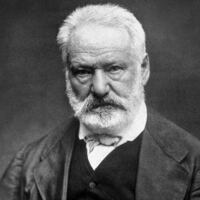
Victor Hugo “Contemplations” (1856) 1: 23. Childhood.
The child sang. The mother, exhausted, in bed,
Lay dying, her lovely head bowed. Shadows clung.
Death loomed in the clouds floating over her head;
And I heard that death rattle, hearing that song.
The child, near the window, was five years old;
His laughter and games made a charming racket;
And the mother—as this poor, adorable child
Sang all day—spent all night coughing and hacking.
The mother now sleeps under cloister stone;
And the small child begins once more to choir it… —
Sorrow is a fruit: God does not make it grow
Upon a branch that is too weak to bear it.
Paris, January 1835.
Victor Hugo “Contemplations” (1856) 1: 22 The Party at Thérèse’s
The affair was exquisite and skilfully laid.
It was in April, on so temperate a day
One might have thought Love himself its planter.
Thérèse the Duchess—to whom I would grant her
Paris were I king, or the world were I God,
Even were she nothing but Thérèse the Blonde;
That lovely Thérèse, with eyes like diamonds—
Had invited us to her charming garden.
The company was small; selection was key.
We were all together, yet each pair in intimacy.
Couples wandered slowly in every direction:
Proud lords’ and rare beauties’ interaction,
Amyntas dreaming beside their Léonores,
Marchionesses laughing with Monsignors;
And, prowling the grand staircase, one saw appear
A dwarf stealing purses from each cavalier.
At noon: the spectacle accompanied by harmony.
Why perform Plautus at night? Comedy
Is a fair maiden who laughs best by day.
Thus—like a temple of love—they’d made
Near a shaded pool where a swan resided,
A trellis-work theatre, twining vine-sided.
An open-work arch—in shape, basket-handled,
Like a green cage where a captive finch warbled—
Covered the entire stage, and the actresses smote
By shadows of branches across their white throats.
Magical harmonies chimed from afar;
And above, coming waist-deep from frieze, to draw
The whole of the crowd to his repeated hijinks,
White-clad Pulcinella sounded his syrinx.
Two fauns supported the proscenium arch; while
Trivelin laughed in their faces like a rascal.
Amidst the ornaments carved in the trellis,
Columbine slept within a great seashell, as
Baring her bosom and arms, could be seen as
A goddess upon the conch—and call her Venus.
Lord Pantaloon, in a niche on the right, made
Use of a bench selling sweet lemonade,
Crying out now and then: “Lords, man is divine!
God made the water, but man has made wine!”
On one side Scaramouche belaboured with bat
The tragic Alcantor and mournful Arbate;
Crispin, black-clad, waved his fan up and down;
Perched on the gateway, one leg dangling down,
Carlino leaned forward, listening to the serenades,
His foot traced dreamy shapes in the air as it played.
The sun served as chandelier; seasonal June
Had embroidered a wide rolling lawn with blooms—
A green carpet on which many groups were ranged.
Lined up on both sides of the rustic stage,
The park’s true trees—lilacs and rowans,
And ebony trees laden with April’s growings—
Exhaling delights with their fragrant sap,
Seemed to amuse themselves by holding things up,
And, opening their blossoms like eyes, watching,
Joined their joyful murmurs to the violin;
So that, in this graceful concert classical
Nature’s was joined by everything musical
Everything charmed: woods, serene day, air pure,
The women all love, and the sky all azure.
As the play was excellent, though of a great age.
With Pierrot, sat nonchalant at the edge of the stage,
Haranguing—his discourse solemn-ing along—
A ape playing kettledrums astride a dog.
Just that: simple and love. — And there were times
The monkey in a frenzy would bang on his drums;
And Pierrot would say. — Listen! If you wish.
One man had the valet bring him some ice;
Another, a gallant in a fanciful casque,
Spoke softly to his lady while tying on her mask;
Three marquises sat at a table, singing a melody.
Thérèse sat in the shade of a small tree;
The roses compared to her cheek seemed pale,
And, seeing her loveliness, a peacock fanned its tail.
Me, I listened, pensive, to a ditty of snark
That an abbé in violet robes hummed in the dark.
Night fell; all grew silent; the torches were spent;
In darkening woods the springs murmured laments;
The nightingale, hidden in its shadowed nest,
Sang, like a poet, like a lover, his best.
Everyone scattered beneath foliage throng;
The giddy ones, laughing, swept the prudent along;
The lover and his beloved walked in shadows away;
And, in a daze like that of a dream, they say
They feel—gradually mingling their souls,
With their burning glances, their whispered words,
With their hearts, their senses, and their yielding reason—
The blue moonlight that bathed the horizon.
April 18…
Victor Hugo “Contemplations” (1856) 1: 21
She had no shoes, and dishevelled hair, she
Sat barefoot among the drooping reeds;
I, as I passed, thought I saw a fairy,
I said to her: Will you come out to the fields?
She looked at me with that supreme gaze
That beauty retains in its victories
And I said: Shall we, in these, Love’s own days,
Shall we go together into the deep trees?
She dried her feet on the bankside grasses;
She cast on me a second look, as she could,
And the playful beauty then became pensive.
Oh! how the birds sang deep in the wood!
How gently the water caressed the shoreside!
I saw come toward me, through tall green reeds, this
Beautiful girl, happy, startled, and wild,
Her hair in her eyes, laughing in the midst.
Mont.-l’Am., June 183..
Victor Hugo “Contemplations” (1856) 1: 20 To A Blind Poet
Thank you, poet! — At the pious threshold of my house,
Like a divine guest, you come and reveal who you are;
And the golden halo of your radiant verse
Shines around my name like a circle of stars.
Sing! As Milton sang; sing! As Homer sang.
The sensual poet cuts through sombre clouds;
The blind see in shadows worlds of brightness frank:
When the eye is extinguished, the spirit unshrouds.
Paris, May 1842.
Victor Hugo “Contemplations” (1856) 1: 19 An Old Song of Youthful Days
19. An Old Song of Youthful Days
I was not thinking of Rose;
Rose and I went to the woods;
We spoke of something—who knows?
I no longer remember our words.
I was as cold as marble;
I walked with absent tread;
I spoke of trees, of myrtle;
‘What now?’ it seemed she said.
The dew offered its pearls,
The thicket its sunshine shade;
I walked; I heard blackbirds,
And Rose the nightingale.
I, sixteen, was quite morose.
She, twenty; her eyes agleam.
The nightingales sang of Rose,
And the blackbirds whistled at me.
Rose, standing tall and fine,
Raised her lovely, trembling arm
To pluck a blackberry from its vine;
I did not see her white arm.
A stream, cool and deep, spilled,
Over stones velvet-mossed;
And nature, love-filled,
Slept in the vast woods, hushed.
Rose unfastened her shoe,
And, with an artless air, put
Her small foot in the water blue;
I did not see her bare foot.
I didn’t know what to say the while;
I followed her through the trees,
Seeing her sometimes smile,
And sometimes sigh unease.
I only saw how lovely she was
Leaving these vast, hushed ways.
‘So,’ she said; ‘let’s think it no more’.
Since then, I have thought of it always.
Paris, June 1831.
Victor Hugo “Contemplations” (1856) 1: 18 The Birds
I dreamt a deserted graveyard, wide-spread,
And heard the duet of my soul and the dead,
Among flowered lawns and tombs cross-adorned.
God wills that what falls should ignite what is born.
And the shadow filled me.
———————————Around me, a crowd
Cheerful, heedless of my sad head bowed,
In this field, bedchamber of ultimate sleep,
Free sparrows played truant and hide-and-seek.
Eternity teased by the here and the now!
They came and went, singing, flying, hopping about,
Scratching at death with their sharp little claws,
Smoothing their beaks on a statue’s sad nose,
Pecking at the tombs, those seedbeds of mystery.
I took these winged noisemakers seriously;
Cried out: — “You harpies! Grant peace to the dead!”
“We’re sparrows,” is what these impious creatures said.
“Silence! Go off!” I retorted, harsh, groaningly.
They flew off because I was strongest—but only,
One still remained behind, and, with his bold music,
Lifted his tail up and said: “Who’s this old classic?”
As they all departed, furious, unjolly,
Shouting, and glaring at a giant black holly
A tree lost in thought near a tomb: a wise man,
Suddenly grabbed me by the sleeve as I ran,
And said: “This is these birds’ purpose, their rightness.
Leave them alone. We need this ray of brightness.
God sends them. They bring life to the cemetery.
Man, they are the joy of all nature’s hymnary.
They take its light, the murmur from the stream,
From the star, the smile of dawn’s enchanted gleam;
Wherever a wise man laughs, they carry his joy,
And bring it to us; shadows blaze at their employ;
They fill their beaks with schoolchildren’s calls;
Through man and grass, through bushes, waterfalls,
They go plundering joy in the vast universe.
They possess a reason which seems to you perverse.
They pity us lolling in sadness, far from their throng;
And, when they are full of their game and song,
Of eclogues and kisses, all the gossip that’s made,
They make nests in April beneath the green shade,
They come running, joyful, charming, lightly, they rave,
To pour it all into our frightening graves,
And come, from palaces, from woodland and hut,
To empty this brightness all into our night!
When May brings them back to us, O dreamer, we say:
Here they are! Everything stirs, stones, mounds, hay;
The smallest shrub speaks, and the grass is ecstatic;
The weeping willow sings, its phrasing emphatic;
The old yew tree, chattering now, confesses;
They gossip about man’s life with the hearses;
They unsnick the clasps of the too-pompous shrouds;
Mocking our marble; spell old words aloud;
And I, who am here amongst old, sulky weeds
Before whom the Lie shows its ugliest screed
Where shamelessly I’m of the tourist crowd,
I find it just, friends, that by reading aloud
Epitaphs styling dead as blessed in the hereafter,
They should make the whole graveyard burst with laughter.
Paris, May 1835.
Victor Hugo “Contemplations” (1856) 1: 17 To Monsieur Froment Meurice
17 To Monsieur Froment Meurice
We are brothers: the flower
Is fashioned in doubled art.
The poet is a sculptor,
The sculptor is a poet.
Through us, poet or sculptor,
Spirit becomes scrutable.
We make the good better,
You make beauty more beautiful.
On her neck or on the arm,
You make from your dreams,
Sculptor of the jeweled charm
Palaces of precious gems!
Don’t say: My art’s a blank …
Step beyond the threshold,
Magic craftsman, make:
Blending thought with gold!
True thinkers take no stock
Who ends it or who starts:
They sculpt from the same rock.
This rock is immense art.
Michelangelo, great old man,
In large blocks he hurls around,
Makes it spring forth at random;
Benvenuto breaks it down.
And, before infinite art’s endlessness,
Whose law is changeless, locked,
Cellini’s crumb-small part
Is worth Michelangelo’s block.
Everything is grand. Red or dun,
Each bright fire’s a soul-claim.
The star is worth the sun;
The spark is worth the flame.
Paris, October 22, 1841.
Victor Hugo “Contemplations” (1856) 1: 16. Circa 1820
So Denise, your husband—our old pedagogue—
Is out for a stroll; grubbing a new eclogue
With “fairest young April upon forest clearing.”
All tremble, pedanticize, at his appearing:
The ass grunts some Latin to ox, his mate;
The wind drones some dull prose, the tree a tirade;
The greening briar-rose—soft, growing young-man—
Cites Theramenes’ tale, and struggles to scan:
“His broad brow is arméd with menacing horns.”
Denise, in the meantime: you dream, you sing songs,
Your age is when innocence shows its dark bloom;
With your unknowing eye—neither joy nor gloom,
Nor fear nor desire—you’re watching, as hubby
Returns to his room and the scholar to study,
The pair approach you, and they climb stairs together:
The schoolmaster Boredom, the schoolboy Lover.
Victor Hugo “Contemplations” (1856) 1: 15 The Ladybird
She said: Some little speck
Torments me. So I stared:
On her snowy neck there
A tiny pink insect.
I should have—(but, wise or thick,
At sixteen, one is glib)—
Seen the kiss upon her lip
More than the bug on neck.
It looked like seashell conch;
Its pink back black-freckled.
Above us, songbirds settled
To watch us from their branch.
Her cool mouth was on my way
As I bent in, allured,
And I took the ladybird,
But the kiss flew away.
“Son, learn now my name,”
Said the bug of the blue sky,
“Animals belong to the Divine:
But foolishness to man.”
Paris, May 1830.
Victor Hugo “Contemplations” (1856) 1: 14 In Granville 1836
So: it’s June. Sparrows rail
At lovers in the fields;
The wall-dwelt nightingale
Sings, stone nest concealed.
The branches and the grasses,
Dog- and sigh- filled,
Repeat their suave choruses
In depths of the wood.
The thrush and the turtledove
Prolong, on nest-soft branch,
The sweet quarrel of love
Of kisses and romance.
Beneath the plain’s fine fences,
Caves, green willows sway,
Vergil intoxicates Silenus,
Rabelais, Grandgousier.
O Vergil—fine wine: pour me!
O Rabelais! Fill the glass.
The forest is a glory;
The cavern a palace!
There’s no lake, isle in-middle
Where birdlime doesn’t snare us,
Where we don’t sing an idyll,
Where a duet doesn’t pair us.
For love hunts in boscages,
Love fishes in the streams;
And fair maidens are the cages
Our hearts the birds within.
From the spring within its basin
Water mirrors flower,
Bids “Good morning” as the jay sings,
“Good evening” to the owl.
The roof awaits its thatch mats—
Bread first, next sheafs for good;
The ox’s flank amongst the grass
Seems a mountain in the wood.
The pond laughs at the sea-ducks,
Field laughs at oriole,
While the deep-set grounded ruts
Groan as great wagons roll.
From a wallflower gold peeks;
Zephyr, old-myth-proud,
Blows with puffed-out cheeks
Deep inside blue cloud.
Jersey upon the docile swell,
Draped in skies so pure,
Adopts a Sicilian veil
And a vast cloak of azure.
Everywhere eclogues are writ—as
Far off as cold Albion
The air’s filled with Theocritus,
The wind recalling Bion;
Repeating the melancholic,
Song once hummed forth
By Moschus—that grig bucolic,
Upon Etna’s hearth.
Winter, old man, coughs, sick:
The mist dissolves; he goes;
The lapping waves provide the music
For verses trees compose.
All of sombre nature is displayed,
Pours forth mysterious glow;
The dreaming soul holds more shade,
And the flower holds more love.
The grass bursts into daisies;
Scents—deemed mute—and powers
The secret sorrow’s phrases
Bindweeds to cornflowers.
Myriad tiny white wings branch
Upon the water’s furrow
Descending in an avalanche;
Its butterflies pour snow.
And on the sea, reflecting together
Dawn’s enamel smile,
The purple-violet heather
Capes ancient mountain-isle,
And addressing the abyss
Holding, blessing brighter—
Intones its sublime mass
Beneath its granite mitre.
Granville, June 1836.