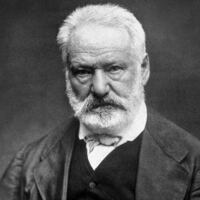
Victor Hugo “Contemplations” (1856) 2:4 Song
If you have naught to say to me,
Why come to my side?
Why do you smile that way to me—
Smile no king has denied?
If you have naught to say to me,
Why come to my side?
If you don’t want me to render,
Why do you press my hand?
That dreamy, angelic, tender
Thought as you walk the strand—
If you don’t want me to render,
Why do you press my hand?
If you want me to depart,
Why do you come so near?
When I see you, I up-start:
You’re my joy, you’re my care.
If you want me to depart,
Why do you come so near?
May 18…
Victor Hugo “Contemplations” (1856) 2:3 Omphale’s Spinning Wheel
In the hall a fine ivory spinning wheel is set.
The nimble wheel is white, the distaff black as jet—
An ebony distaff with lapis inlay snug.
It rests in the atrium upon a gorgeous rug.
An artisan from Aegina has carved, at its base
Europa, and a god who does not heed her pleas.
The white bull abducts her; Europa, forlorn,
Cries out, shrinks in terror, casts her eyes down,
Sees monstrous Ocean kissing her rosy feet.
Needles and thread, half-closed boxes and pleats
And Miletan purple- and gold-dyed wool,
Fill up a basket by the dormant spinning wheel.
Yet, loathsome, frightful, and immense, they come
From deep in the palace, twenty foul phantoms—
Twenty blood-stained monsters, only half-seen—
Teem round the slumbering wheel: the Nemean
Lion, the hideous Hydra of Lerna,
Cacus, dark brigand of dark cavern inner,
Three-bodied Geryon, the typhoons of the seas
That, at nightfall, blow with clamour through the reeds;
Each bears on his brow a club’s mark, ghastly bruising,
All—lingering at a distance, menacing—
Fix their dark, humbled eyes on the wheel, splendid,
Where a supple, knotted thread hangs suspended.
June 18…
Victor Hugo “Contemplations” (1856) 2:2
My verses would fly, sweet weaklings,
To your beautiful garden world,
If only my verses had wings,
Wings like a bird.
And they would fly, like leaping flames,
To your laughing heaped hearth-coal,
If only my verses had wings,
Wings like the soul.
They’d near you, as pure faithful things,
Drop night and day quick from above,
If only my verses had wings,
Wings like love.
Paris, March 18…
Victor Hugo “Contemplations” (1856) 2:1 The First of May
It all conjugates the verb “to love.” Look—roses!
I speak of nothing else in all my poetries.
First of May! Love—joyful, hot, jealous, high—
Makes the woods, nests, the flowers, even wolves, sigh;
The tree with its motto which, last autumn, I incised,
Repeats it as its own, as if just improvised;
Old, pensive caves—where the mocking jay laughs—
Twitch heavy brows, purse lips, shaping a heart;
The atmosphere, tender and aromatic, sings
With declarations the land offers to Spring,
Which lovestruck grass whispers to enchanting sky.
Across the blue firmament Day passes by,
The countryside, deeper in love, at crosstrees,
Lavishes odours, and, on the mild breeze,
Sends its fragrant kisses to the returning season.
These bouquets—azure, carmine, saffron, crimson—
Whose breath drifts away, murmuring: “I love you!”
Across the ravine, pond, field, even the furrow,
Scattering splashes of every colour;
And, gifting perfumes, earth has kept the flower—
As if her sighs and tender epistolaries—
Sent to May-month, laughing amid languid trees—
And all the love notes of her garrulous heart,
Had imprinted on a blotting pad its mark!
In the woods, the birds—their voices soft and low—
Sing to the fairies: triolets and rondeaux;
Everything confides sweet secrets to the shade;
Everything loves, whisper-confessing. It could be said
That north, hot south, west to sunset, at the dawn
The flowering hedge, the ivy, and the murmuring spring,
The mountains, the fields, the lakes, and the oaks swaying
Repeat the four winds’ composed quatrain.
Saint-Germain, May 1st, 18..,
Victor Hugo “Contemplations” (1856) 1:29. A Halt on the Way
A mist once veiled the horizon; but now
Bright noon comes up with her radiant brow;
On the branch fog distils into pearls flecked, as
Gleaming diamonds on periwinkles’ necklace.
The wind blows between trees and over the roofs
Of a dark hamlet, hidden thatched eaves in the woods,
And one can see—scattered amidst leafy oaks—
The faint, drifting wisps of up-trembling smoke;
Between high banks a rivulet runs through meadows,
Under the restless sway of long-haired willows;
Elm and Beech—ancient denizens of the vale—
Brother trees on opposite shores join hands in hail—
Seeming to say, under blue sky, “here’s good faith!”
A bird pours out song, filled with both love and grace,
A flutter of leaves and wingbeats; the pond brimming
And glistening under green dragonflies skimming;
A hut is revealing there—nestled in thyme and sage—
Amidst pewter mugs, smiling, sits an old saint.
With sunlight like this, beside banks flower-patterned,
It might be a temple, or maybe a tavern.
Whether it’s lips that thirst, or it’s our hearts,
We praise Good God, for His cup as we depart!
We go in. — “What have you?” — “fresh eggs and cool drink.” —
It resembles a manger whose roof starts to sink.
At meadow’s spring, sheltered by foliage’s green bar,
A blonde child has come to fill the water jar—
Joyful, lifting the hem of her fustian skirt,
Dipping her pitcher in the fountain’s spurt,
The water was gazing with soft, murmuring awe
At this lovely little girl with eyes of azure.
And beside a great bed draped in old serge, I watch
Pensive, an image: Christ scourged by the lash.
What do they matter, martyrs suffering abuse?—
Insults from all sides, from each age spittle-sluiced,
The blind man’s futile clamour, eternal jeering
In which the mob’s always blindly careering?
In time, the scourged wanderer comes to be God;
His bruises high-sky-blue, him dark, bleeding-browed,
In shadows—church, palace, hut come into view—
The crucifix whitens, Christ acquires heaven’s hue.
One day, crowds will follow; go forth now, blood-gushed,
Suffer, O thinkers—by your tormentors’ tears washed!
Sorrow consecrates saints, sages, thinkers of breadth;
A halo blooms trembling amongst shame’s dark depths,
And over this vile swamp—a glimmer from above—
Is an eternal flame, ghostly, in quagmires of blood.
The selfsame fate leads all toward the same story.
Deep in the fabric of our human history,
Lies an abyss of sorts, where, one’s by one’s,
All who belong to life and to light plunge—
The good, the pure, great, divine, the famous;
Like torches tossed wild in the breath of the dimness.
There, we see Dante is swallowed up—in go
Socrates, Milton, Thomas More and Scipio
Aeschylus, holding his trembling leaf palms.
A night from which their soaring memory comes!
Their complete all in their sacrifice for us.
From Aristides’ exile to the stake of Jan Hus,
Mankind—in its so frequent pensive state—
Dazzled, at the abyss, dreams of the great.
They are—it’s law for high, descending ones—yet
Like you, O Sun! Most glorious at sunset;
And, O proud Niagara, whose waters roar-brawl,
They’re like you: their finest quality is their fall.
A man who once bound Jesus Christ to the rack,
Who cast a vile cloak across His bare back,
Tore from that tranquil brow a grasp of hair
Drenched in the sweat of His resignation there,
Saying, ‘Oh, I shall show Caiaphas this!’
Then walked away, clenching his dusky fist;
As night fell, the street becoming shadow-locked;
The man walked in darkness—then suddenly stopped,
Stunned, pale, as if overwhelmed by insight,
Trembling!—in his hand he held—rays of light.
Forest of Compiègne, June 1837.
Victor Hugo “Contemplations” (1856) 1:28
The poet must, as he loves shade and azure,
Gentle, grand spirit, whose radiance is pure,
Who walks before all, enlightening the uncertain,
Mysterious singer to whom, trembling, hearken
Women and dreamers and sages and lovers —
Must at some moments grow stronger, grow tougher.
Sometimes, when a book first provokes its dreams,
As all soothes, beguiles, dazzles, caresses and calms
Where the soul, at each step, finds sustenance, where
The darkest recesses are lit by sky’s glare,
In the midst of this humble and lofty verse,
Where the chosen flower grows in its sacred peace,
Where the flowing of springs and of tears are heard,
Where the stanza, like a thousand-coloured bird,
Flies singing of love, hope, jollity,
One must, from time to time, shiver to see
Suddenly, dark, grave, terrifying those who are nearing,
A tawny verse emerge from the shadows roaring!
The poet with his fertile seeds must be
Like the deep forest, fresh and green,
Full of songs, love of the wind and the sunrays shine on,
Charming, where suddenly, one encounters a lion.
Paris, May 1842.
Victor Hugo “Contemplations” (1856) 1:27
Yes, I am the dreamer; I am companionable
To the tiny golden flowers on a crumbling wall,
And I hold discourse with the trees and the breeze.
All these things know me, as anyone sees.
In May, when the branches are heavy with perfume,
I engage in conversation with the wallflowers’ bloom;
I take counsel from cornflower and ivy at root.
That mysterious being you deem to be mute
Leans over me, and uses my pen to write.
I hear what Rabelais heard; I see, some cried
Some laughed; and I hear what Orpheus heard.
Do not be surprised by all I am told
By ineffable Nature’s sighs. I’m he who converses
With all the voices of metempsychosis.
Before the great sacred concert begins,
The sparrow, the bush, the meadow’s living springs,
The forest—that vast bass—flowers, birds flying free,
All these gentle instruments speak to me.
I often attend this divine orchestra to hear it.
If not a dreamer, I might have been a sylvan spirit.
Through the calm in which I gather my beliefs,
And by dint of speaking softly to the leaf,
To the raindrop, to the feather, to light’s rays shone,
I have descended so deeply into Creation—
That abyss where wild, primal tremors strike—
That I no longer even startle a fly into flight!
The grass-blade quivering with an eternal glee,
Grows tame and becomes familiar with me;
And, quite unaware that I am even there,
The roses and bumblebees carry on their affair;
Sometimes, amidst the boughs, soft and blessed,
I lean in close to gaze upon the nests;
And the little bird—that anxious, holy mother—
Fears me no more than we would if we discovered
The eye of God peering into our own retreats.
The modest lily watches my approach without fright
As the violet unfolds to the day’s kiss
Bashful, tends to its toilette before I wash;
To these fair things, I am a discreet and trusted ally.
And the sprightly butterfly—that libertine of the azure sky—
Who playfully ruffles the petals of a half-unveiled bloom,
Does not pause even when I pass through the gloom;
And if the flower hides itself in the grass,
He says to her: “Don’t be silly! He’s here—he belongs to us.”
Les Roches, August 1835.
Victor Hugo “Contemplations” (1856) 1: 26. A Few Words to Another
We return to the subject; I can’t float above it:
What’s attacked in me is my era, and I love it.
Surely, I’d be left in peace, passerby, obscure,
Did I not hold—an atom of the azure—
A fragment of the great ray by which our age is made.
Yesterday the citizen, today the bard.
The ‘Romantic’ follows the ‘Liberal.’ — Come on!
Go! Snap at my heels as I trundle along.
I am the dark figure through whom all things grow rank.
Hurl your next thunderbolt at my other flank.
You, too, saw me when I was young, and now
You denounce me—oh my good fellow, you too—
Tearing me apart with the greatest cheer,
Moved by memories childhood, my hair fair.
You cry out: “What, Sir! What is this cast before it?
Stanzas go barefoot! Drama has no corset!
The Muse throws her innocence-robe to the wind!
And Art shatters rules as: ‘we are growing’!” —
Literary Gerousia with your plaintive jeers,
You marvel—in your ‘retrospective’ verse—
That my voice disturbs the order, that this Romantic
Lives on, this little one—to whom ‘Art Poetic’
So kindly gave water and bread and cheese—
Has grown such a burden on Boileau’s knees!
You gaze at my verses, at its talons and wings,
Its refusal to march behind old modelings
As junior clerks trail after their deans;
You see, flashing from them, sinister gleams;
Horror! And you, shrieking with hyena bray
Peer through the bars of the Ev-er-y-day.
You exhaust your whole notebook on me and mine,
Citing Father Bouhours and Father Rapin;
And, crushing me with names, all nobiliary,
You unleash the ultimate epithet: Revolutionary!
At this, the pedants all chorus: ‘Amen!
I am arrested; I’m set an exam in
The stammering Sorbonne, school scribbles away;
From twenty pens bursts-out a farcical fray:
“What do these foul innovators want?—verse? this?”
Before their black books, read in the night’s blackness,
Female readers tremble deep within their retreats.
Mount Pindus hears rhymes as roaring wild beasts,
And shudders. Because of them, today all is dead;
The alexandrine tears caesura to shreds;
Like grass and sage ripped up by wild swine,
Enjambment flounders in the midst of the line;
What is to become of us? Richelet can’t fix it.
Everything requires a Magister dixit.
Let us go back to The Rules, flee this taint;
Hippocrene is water; thus, beauty is restraint.
The wise are bound by reason for their part,
Have always consulted Quintilian on art,
Leibniz on maths, on war take Vegetius’s advice.
When impotence writes, it signs its name: ‘Wise’.
I see no reason why I should not tell you this
As I have told others without shaking my fist.
Well then, let’s unmask! True, our soul is shadowy;
Cast off the straitjacket of formal oratory.
We’re pushing language toward a new horizon,
With rhyme, in its wake, sweeping along reason,
Launching—at the double, into pitched battle—
All rebel force against one La Harpe, rattled.
We attached a firebrand to the style of old:
Liberty! In that same conspiracy we’ve enrolled
The Spirit—poor devil—and the Word—poor fool;
We tore off the hood, hairshirt, the monk’s cowl
That once cloaked the Idea—that vision diviner.
We raged in a throng—orators and writers,
And poets alike; all pointing to the hour,
We told Rhetoric: ‘Come, you’re a big girl now,
Lift your eyes!’ — And me, singing, defying, a brawler,
I twisted the bars of the convent’s front parlour;
Torch in hand, I threw wide Drama’s doubled door;
And just like pirates, with sail and with oar,
We seized the Three Unities’ dry archipelago;
I sounded the rally at trembling Helicon.
Lost! Unmuzzled verses dart wild through the scene!
We prefer Molière to a startled Racine;
Oh, pedants! We’d rather Rotrou than Ducis.
Who’s this? Lucrezia Borgia? ’tis she!
Mixing foul poisons into all your sweetbreads;
Disheveled Drama smites fear upon your bald heads;
It is horrible! Yes—brigand, Jacobin, crime—
I have broken that great simpleton, the alexandrine;
Refined words, those syllable posh-os,
Lived together deep in their exquisite grottos,
Pursing their lips, speaking just to each to the same;
I told the low words—one-armed, goitrous, the lame—
‘Stand tall! Soar! Mingle in here without rules
In the vast, rampant cavern of the eagles!’ —
I have confessed my crimes are killer-diller.
Yes, I am Papavoine, Herostratus, Attila.
And then?
—————Fly into a rage, call the guard,
Good man! Storm! Thunder! I’m watching you hard.
Our ‘so-called progress’ strikes you as shocking;
You loathe this people’s century where, when, talking,
Verse abandons the customary three bows;
A dark age, we writes as we think, uncowed,
Where one is a philosopher and a poet in the raw,
Where all dreamers are drunk on your sincere,
Adorable, foaming wine—O Ideal Unkind.
You open our books and shield your eyes—blind
With the brightness of the mot juste’s burning;
Execrate our frank, true verses; you screaming
In fury at the sight of our naked verses.
But where, then, is the time of nymphs unrehearsed,
Who ran through the woods, and whose nudity
Danced in the evening of summer’s lucidity?
As the window is opened at white naked dawn,
The modest and prudish mist-curtain is drawn,
A fig leaf is stuck on the star in the azure?
Is the ‘Tasteful’ of waves—shells of love!—so poor?
O Virgil! Pindar! Orpheus! Veil in gauze,
As if it obscene, the wings of Pegasus—
Who, unfolding them on the blessed mount, is,
Like the vast butterfly of the infinite kiss?
Is the magnificent sun a cynic?
Is the flower wrong to cast off its tunic?
Does Calliope—in the sky as she hovers—
Wrong the pensive Dante when she uncovers
Her dazzling breasts through the stellar dark?
You are a relic of yesterday. Free, uncloak
Great naked Olympus would make you cry: “Urk!”
You would make chubby Cupid put on a skirt.
Your taste tends to tinsel, the nine sisters posh,
To Évrard Titon du Tillet’s Parnassus;
To you, the Maenads would be dancing the can-can;
Apollo would strike you as a Mohican;
You would take Venus for a savage woman.
Age—which is often totals our wisdom’s sum—
May well grumble to you in a low tone: “You’re wrong;
You will make yourself cough if you shout so strong;
For the sake of a few chance and wild novelties,
Sir, do not disturb the peace of your qualities!
These folk go their own way; how does it harm you?
They find only ash in the fire that once warmed you.
Why declare war on the noise that caused you annoy?
This century’s as liberal as you were once a pageboy.
Shut tight your shutters, draw your curtains closed tight,
Blow out your candle, and block all of it out!
What is the true sage’s soul? A deaf-mute.
What do you care if this poet or that,
Like a bird of the heavens, comes singing his song;
And if some Pindaric rascal—some nursling
Of the Muses—amidst a Corybantic crashboom,
A sullen brat, has bitten their slightly sagging bosom? —
You heed none of this, and you listen to nary any.
Voltaire—great man, yet hardly ‘Voltairean’—he
Whispers in vain in your ear: “Friend, you’re a bore!"
— You foam with rage! — starting from the fact that we core
Men of anarchy-age, this hell, are laying
Siege to the great Louis, perched on twenty great names;
You say that, after all, we are wasting our effort,
That the climb is steep and our breath runs short;
That the verdict is in: we shall never ‘successifize’;
That Batteux stares at us with his big, round eyes,
That Tancrède’s made of bronze and Hamlet of sand;
You declare Boileau a wig that refuses to curl; crowned
With laurels, with our a sidelong glances,
You point out the rubbish heap of our verses—
That dung-pile where this century’s ugliness struts—
To poor old Good Taste, that sweeper of Parnassus;
And, bolder still, you shout to us again:
‘I shall sweep you away myself!’ —
——————————————————Sweep away, then.
Paris, November 1834.
Victor Hugo “Contemplations” (1856) 1:25 Unity
Beyond the horizon where browning hills tower,
The sun, that infinitely splendid flower,
Bent down to the earth at sunset, and revealed
A humble daisy, blooming at the edge of a field,
On a grey wall, crumbling among the wild oat,
White and unfurling its candid halo;
And that little flower, above the old wall,
Gazed fixedly into the endless azure,
At the great star pouring forth, immortally lit.
“And I, too, have rays!” she declared to it.
Granville, July 1836.
Victor Hugo “Contemplations” (1856) 1: 24
Happy’s the man, occupied with eternal fate,
Who, like a traveller setting out as day breaks,
Awakens, his mind filled with reverie,
And at daybreak begins to read and pray!
As he reads, the day is slowly coming nigh:
It dawns in his soul as in the high sky.
He sees distinctly, in this pale light,
Things in his room and sees in-self insight;
He alone believes, as everyone else sleeps.
And yet, with hushing fingers upon their lips,
Behind him, as ecstasy has him moonstruck,
The still-smiling angels lean over his book.
Paris, September 1842.