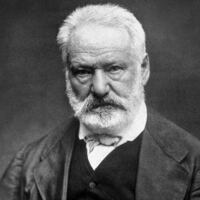
Victor Hugo “Contemplations” (1856) 1: 13. On Horace
Peddlers of Old Greek and Latin! Pedants! Dogs!
Philistines! Teachers! I hate you, pedagogues!
In your solemn, infallible, dull confidence,
You deny the ideal, grace, and beauty at once!
For your texts, your laws, your rules: all mere fossils!
And, beneath an air of profundity, you are just tossers!
You claim to teach everything, yet you know nothing!
Your ways are wicked and mean! — My blood’s seething
At the mere thought of me as a dreamy ass,
A lanky sixteen-year-old in the rhetoric class,
I endured such boredom! Rage! Folly! — Head-blocks! —
Such cold punishments and such sudden shocks!
— Sunday in detention and “Horace: five hundred lines!” —
I’d gaze at the monster with his nails begrimed,
And stammer: “Sir…” — But no: “no excuses!
Twenty times: ‘Plancus’ and the ‘Epistle to the Pisos!’” —
Yet that very day—oh, sweet notional idea
That made me dream then of Armida and Haidée—
I had a tryst with the doorkeeper’s daughter.
Great God! To lose such a day! All gone for naught! I
Had meant—while speaking of love, of pure bliss!
Intoxicating her with sky and naturalness—
To take her, if the weather wasn’t too grim-grey,
To eat galette cakes up on Butte Saint-Gervais!
Happy dream! I saw it all, in my furious needing—
The holidays, lilacs, the suburbs, that Eden—
And I heard, amidst thyme and lilies-of-the-valley,
The swelling violins of Mother Saguet!
Oh, the anguish! Furious, I would climb to my room—
An icebox in December, a furnace in June—
And there, I would cry out:
———————————— Horace! Friend mine!
You who lived life calmly by reason’s shine,
And who, with your candid wisdom, would perch
Upon all things as a bird lights upon a branch—
Not weighing things down, or lingering, ask gods
For nothing but the time to sing your free joyful odes!
You walked, listening at evening beneath the arbours
Heard the stifled laughter of giddy young girls,
Heard soft whispers in the woods’ dark enclave;
And at times you wooed your beautiful slave,
Blond-haired Myrtale, who would flare up and rear
As the ocean carves out the gulfs of Calabria;
Or else you leaned upon the table, drinking straight a
Glass of wine you poured out of a Greek krater.
Pegasus breathed verses from his nostrils to you, clean;
You mused; you composed various odes to Barine,
To Maecenas, to Virgil, to your Tibur field friends,
To the antique wall by which Chloe wends,
Bearing a fine amphora upon her lovely head.
At night, when Phoebe turned into Hecate the Dread,
The thickets filled with visions for your sight;
You saw glimmers, shapes, darkness, and rays of light;
Cerberus—tail between legs—rubbing up spends time
With Bacchus, god of wine and father of the iamb;
Silenus, pensive, digesting, in a spelunk,
Lasciviously darts into the shadows to get drunk
On the scanty-clad nymphs white nakedness,
The faun with goat-feet and tapered ears!
Horace, when—tipsy on a little Sabine wine-quaff—
You caught Glycera or Lycoris at her bath,
Who could have told you, O Flaccus!—when in Rome
You painted young knights racing the hippodrome,
Just as Molière painted those French marquises,
You were crafting beguiling, profound, fine verses
To serve—in this odious age of ours—
As instruments of torture for horrible fellows,
Disheveled and ill-clad, who—dull pedants—devour
Your name with their teeth as an ape chews a flower!
Hideous scribblers who—their heads being clear—
Have never had girlfriend nor had an idea!
Then I’d add, fierce:
—————————— O dunces! You who dress-up
The angry gods of the ether in cassocks,
Put a nightcap on Diana, and grimly place at
The heads of sombre Olympians your three-cornered hats—
Eunuchs, tormentors, cretins—be accursed!
For you are the sluggishness, old, dark, the worst;
For you are the winter; for you are—O ninnies—
The bear roaming the woods for a tree full of bees,
The shadow, the lead, the death, tomb, the void!
No one sits upright beside your stance sigmoid;
And you petrify with your stone-foulness of breath
Each innocent, radiant, splendid youth;
And you draw near the dawn, O you brings of slumber!
To serene Pindar, filled with far epic thunder,
To Sophocles, Terence, Plautus, and ambrosia,
O traitors, you mingle ancient Hypocrisia,
Your darkness, your morals, yokes, exeats, rotas
And the stupor of grim, sanctimonious cloisters;
Your claw-marks that scar every most-sublime book,
Your prejudices making your eyes fog-cooked,
The dread of the future, the hatred of progress;
And—fearless, unrepentant and pitiless—
Of youth, virgin hearts, and hope, you’re choking them
By night-forcing on them that stale, ancient opium!
O shutters of the human Bible! Sextons
Of art, of science, and of masters that are ex-!, gone!,
And of the truth with which man spells sky scrabble—
You turn this vast temple into a tiny chapel!
Jailers of spirit, you scoundrels whose ‘acumen’
Leads Beauty on a leash, and locks-away blue heaven,
You take Theocritus, Aeschylus in his sacred veil,
Tibullus filled with love, Virgil through whom stars sail,
And turn all these paradises into hell!
And, my rage mounting, I resumed:
———————————————— Cursed! Fell!
Those deaf monasteries! hated prisons! Pigsty!
Oh! what was done of old to the pedant of Veii?—
Breeches down, old tiger! Schoolboys! schoolboys!
Come swarming, by the thousand, come in convoys,
From the Paris urchin to the Old Roman ‘Greekling’;
Cut green wood, and give that man a good thrashing!
Young mouths, bite the one who ties on the gags!
The shop-window dummy who’s wearing just rags
Has just as much wit as that pedant in his hut,
And just as much heart as that one has fat gut
Full of Latin and Greek as if all stuffed with hay.
Ah! I call Phyllodoce and Xanthis to relay
That I am in love with their bright-coloured tunics;
Whilst hating the vile heap of those pedant-eunuchs!
Entrusting a child—think it—to those black-clad
Pseudo-scholars! One might as well, by God,
Lock up a fly in a tarantula’s house!
Those monks explain Plato, they’r reading Catullus,
Tacitus recounting the great Agricola,
Lucretius!— deciphering Homer, those infusoria?
Those deacons, those beadles with snuffling snouts!
Skulls spewing night, paws ready to grout,
Old oafs with high airs, triumphant brows wild,
Who don’t even know how to spell ‘the child’!
Know nothing of how souls are born, how to foster.
They’ve only La Harpe and Nonotte in their cloister!
They’re stuck on the heart’s A, B, C, D plateau;
They’re the pinched Yesterday trying kill Tomorrow;
Offer their eaglets stale crawfishy rules
And those black shards reeking of vices of fools.
Oh, old goblets chipped by thirsts dare not confess!
Their plural meas culpas take an added ‘S’;
Mysterious he-goats bristle seeing them chaff,
And hearing “Love”—heavens and earth!—cross themself.
Their dead, withered innards insult hearts florescent.
They look down their noses at all adolescents,
They just won’t accept the light entering heart
In the guise of a thought or as woman’s part.
When the Muse appears, these clamorous scoffers
Cry: “Who is this madwoman coming to mock us?"
And, faced by her beauty, brought out by her light,
They sneer: “Harsh colors: the shades are too bright;
Vapours, illusions, dreams—what whim perverse
Makes you cram such a rainbow now into your verse?”
They mock the children, they mock the poets’ lines;
Glare at the nightingales with great owl-eyes;
The child’s just ignorant; they are the pedants of ignorance;
Striking out soul, splendour, and the dawn’s glance;
They weed out the ideal as if it were a solecism,
And those bottle-bottom eyes scorn upon the prism!
Thus I was heard: crying out in my chains.
The monologue had time to shift and change.
And I grew exasperated, committing great wrong—
I was right in substance, yet awry in form.
And after Abbé Tuet, I cursed all Bézout brought;
For, beyond the drudgery that dissolves all thought,
I was then in the clutches of mathematics.
Dark times! A child stirred by poetry’s phatics,
A poor bird banging my skull against the bars,
Sent alive to ‘the numbers’—black executioners;
They forced me to swallow algebra’s dimness;
Shackled me deep inside Boisbertrand’s grimness;
They twisted me, from my wing-tip to my beak,
Upon X and Y and Z’s hideous rack;
Alas! Crammed beneath my maxillaries
The theorem, decked out with all its corollaries;
And I struggled, a lugubrious patient
Aiding the divisor and abetting the quotient.
Hence my cries!
———————One day, when mankind grows sage,
When birds are no longer taught by their cage,
When misshapen societies grasp what is different
Their minds lifted high through the better-known infant,
When—having fathomed the rules of free flight—
We all know the law of the eagle’s birthright,
And when high noon shines for us all, replete:
As knowledge is sublime, then learning will be sweet.
Then, when all will essay mountain-peak etudes
The great Latin-Greek books—those high solitudes
Where lightning rumbles, sea gleams, starlight laughs,
Filled with vast winds of the spirit that blasts—
It is by illuminating with tender good,
By making them loved, we’ll make them understood.
Homer will sweep dazzled schoolboys to sea
In his vast, surging tide; the child will no longer be
A beast of burden yoked to Virgil;
And no longer shall we see that keen spirit, agile,
Become, under some pedant or abbot’s hard whip,
The heavy, wheezing horse of bogged-down hardship.
In a rustic temple, bathed in light, each village class a
Replacement—in place of the old schoolmaster
So gloomy no daylight could never penetrate—
The clear-sighted, true teacher: a magistrate
Of progress, a healer of ignorance, a priest
Of the ideal; we’ll see vanish into the mist
The eternal schoolboy and the eternal pedant.
Dawn comes singing, not growls of dread. And
Our sons will laugh at us in that bright new reach;
They’ll wonder how we ever hoped to teach
The sparrow by means of the haggard owl’s rage.
And then, the young mind and the youthful gaze
Shall rise to the skies with serene clarity
Towards august, kindly, sovereign verity;
Then, no more obscure tomes, dull, stifling, awful;
The teacher—bending over the child, sweet apostle—
Shall pour out God, blue sky, and true comradeship,
Bid the little soul drink from the infinite cup.
Then all shall be true—dogmas, rights, duties, laws.
You shall let pass, through your dark pillars you shall let pass,
A pure gleam, less dim day by day, shall grow—
O Nature, alphabet of great letters of shadow!
Paris, May 1831.