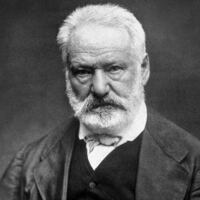
Victor Hugo “Contemplations” (1856) 1: 26. A Few Words to Another
We return to the subject; I can’t float above it:
What’s attacked in me is my era, and I love it.
Surely, I’d be left in peace, passerby, obscure,
Did I not hold—an atom of the azure—
A fragment of the great ray by which our age is made.
Yesterday the citizen, today the bard.
The ‘Romantic’ follows the ‘Liberal.’ — Come on!
Go! Snap at my heels as I trundle along.
I am the dark figure through whom all things grow rank.
Hurl your next thunderbolt at my other flank.
You, too, saw me when I was young, and now
You denounce me—oh my good fellow, you too—
Tearing me apart with the greatest cheer,
Moved by memories childhood, my hair fair.
You cry out: “What, Sir! What is this cast before it?
Stanzas go barefoot! Drama has no corset!
The Muse throws her innocence-robe to the wind!
And Art shatters rules as: ‘we are growing’!” —
Literary Gerousia with your plaintive jeers,
You marvel—in your ‘retrospective’ verse—
That my voice disturbs the order, that this Romantic
Lives on, this little one—to whom ‘Art Poetic’
So kindly gave water and bread and cheese—
Has grown such a burden on Boileau’s knees!
You gaze at my verses, at its talons and wings,
Its refusal to march behind old modelings
As junior clerks trail after their deans;
You see, flashing from them, sinister gleams;
Horror! And you, shrieking with hyena bray
Peer through the bars of the Ev-er-y-day.
You exhaust your whole notebook on me and mine,
Citing Father Bouhours and Father Rapin;
And, crushing me with names, all nobiliary,
You unleash the ultimate epithet: Revolutionary!
At this, the pedants all chorus: ‘Amen!
I am arrested; I’m set an exam in
The stammering Sorbonne, school scribbles away;
From twenty pens bursts-out a farcical fray:
“What do these foul innovators want?—verse? this?”
Before their black books, read in the night’s blackness,
Female readers tremble deep within their retreats.
Mount Pindus hears rhymes as roaring wild beasts,
And shudders. Because of them, today all is dead;
The alexandrine tears caesura to shreds;
Like grass and sage ripped up by wild swine,
Enjambment flounders in the midst of the line;
What is to become of us? Richelet can’t fix it.
Everything requires a Magister dixit.
Let us go back to The Rules, flee this taint;
Hippocrene is water; thus, beauty is restraint.
The wise are bound by reason for their part,
Have always consulted Quintilian on art,
Leibniz on maths, on war take Vegetius’s advice.
When impotence writes, it signs its name: ‘Wise’.
I see no reason why I should not tell you this
As I have told others without shaking my fist.
Well then, let’s unmask! True, our soul is shadowy;
Cast off the straitjacket of formal oratory.
We’re pushing language toward a new horizon,
With rhyme, in its wake, sweeping along reason,
Launching—at the double, into pitched battle—
All rebel force against one La Harpe, rattled.
We attached a firebrand to the style of old:
Liberty! In that same conspiracy we’ve enrolled
The Spirit—poor devil—and the Word—poor fool;
We tore off the hood, hairshirt, the monk’s cowl
That once cloaked the Idea—that vision diviner.
We raged in a throng—orators and writers,
And poets alike; all pointing to the hour,
We told Rhetoric: ‘Come, you’re a big girl now,
Lift your eyes!’ — And me, singing, defying, a brawler,
I twisted the bars of the convent’s front parlour;
Torch in hand, I threw wide Drama’s doubled door;
And just like pirates, with sail and with oar,
We seized the Three Unities’ dry archipelago;
I sounded the rally at trembling Helicon.
Lost! Unmuzzled verses dart wild through the scene!
We prefer Molière to a startled Racine;
Oh, pedants! We’d rather Rotrou than Ducis.
Who’s this? Lucrezia Borgia? ’tis she!
Mixing foul poisons into all your sweetbreads;
Disheveled Drama smites fear upon your bald heads;
It is horrible! Yes—brigand, Jacobin, crime—
I have broken that great simpleton, the alexandrine;
Refined words, those syllable posh-os,
Lived together deep in their exquisite grottos,
Pursing their lips, speaking just to each to the same;
I told the low words—one-armed, goitrous, the lame—
‘Stand tall! Soar! Mingle in here without rules
In the vast, rampant cavern of the eagles!’ —
I have confessed my crimes are killer-diller.
Yes, I am Papavoine, Herostratus, Attila.
And then?
—————Fly into a rage, call the guard,
Good man! Storm! Thunder! I’m watching you hard.
Our ‘so-called progress’ strikes you as shocking;
You loathe this people’s century where, when, talking,
Verse abandons the customary three bows;
A dark age, we writes as we think, uncowed,
Where one is a philosopher and a poet in the raw,
Where all dreamers are drunk on your sincere,
Adorable, foaming wine—O Ideal Unkind.
You open our books and shield your eyes—blind
With the brightness of the mot juste’s burning;
Execrate our frank, true verses; you screaming
In fury at the sight of our naked verses.
But where, then, is the time of nymphs unrehearsed,
Who ran through the woods, and whose nudity
Danced in the evening of summer’s lucidity?
As the window is opened at white naked dawn,
The modest and prudish mist-curtain is drawn,
A fig leaf is stuck on the star in the azure?
Is the ‘Tasteful’ of waves—shells of love!—so poor?
O Virgil! Pindar! Orpheus! Veil in gauze,
As if it obscene, the wings of Pegasus—
Who, unfolding them on the blessed mount, is,
Like the vast butterfly of the infinite kiss?
Is the magnificent sun a cynic?
Is the flower wrong to cast off its tunic?
Does Calliope—in the sky as she hovers—
Wrong the pensive Dante when she uncovers
Her dazzling breasts through the stellar dark?
You are a relic of yesterday. Free, uncloak
Great naked Olympus would make you cry: “Urk!”
You would make chubby Cupid put on a skirt.
Your taste tends to tinsel, the nine sisters posh,
To Évrard Titon du Tillet’s Parnassus;
To you, the Maenads would be dancing the can-can;
Apollo would strike you as a Mohican;
You would take Venus for a savage woman.
Age—which is often totals our wisdom’s sum—
May well grumble to you in a low tone: “You’re wrong;
You will make yourself cough if you shout so strong;
For the sake of a few chance and wild novelties,
Sir, do not disturb the peace of your qualities!
These folk go their own way; how does it harm you?
They find only ash in the fire that once warmed you.
Why declare war on the noise that caused you annoy?
This century’s as liberal as you were once a pageboy.
Shut tight your shutters, draw your curtains closed tight,
Blow out your candle, and block all of it out!
What is the true sage’s soul? A deaf-mute.
What do you care if this poet or that,
Like a bird of the heavens, comes singing his song;
And if some Pindaric rascal—some nursling
Of the Muses—amidst a Corybantic crashboom,
A sullen brat, has bitten their slightly sagging bosom? —
You heed none of this, and you listen to nary any.
Voltaire—great man, yet hardly ‘Voltairean’—he
Whispers in vain in your ear: “Friend, you’re a bore!"
— You foam with rage! — starting from the fact that we core
Men of anarchy-age, this hell, are laying
Siege to the great Louis, perched on twenty great names;
You say that, after all, we are wasting our effort,
That the climb is steep and our breath runs short;
That the verdict is in: we shall never ‘successifize’;
That Batteux stares at us with his big, round eyes,
That Tancrède’s made of bronze and Hamlet of sand;
You declare Boileau a wig that refuses to curl; crowned
With laurels, with our a sidelong glances,
You point out the rubbish heap of our verses—
That dung-pile where this century’s ugliness struts—
To poor old Good Taste, that sweeper of Parnassus;
And, bolder still, you shout to us again:
‘I shall sweep you away myself!’ —
——————————————————Sweep away, then.
Paris, November 1834.