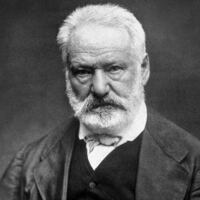
Victor Hugo “Contemplations” (1856) 1:29. A Halt on the Way
A mist once veiled the horizon; but now
Bright noon comes up with her radiant brow;
On the branch fog distils into pearls flecked, as
Gleaming diamonds on periwinkles’ necklace.
The wind blows between trees and over the roofs
Of a dark hamlet, hidden thatched eaves in the woods,
And one can see—scattered amidst leafy oaks—
The faint, drifting wisps of up-trembling smoke;
Between high banks a rivulet runs through meadows,
Under the restless sway of long-haired willows;
Elm and Beech—ancient denizens of the vale—
Brother trees on opposite shores join hands in hail—
Seeming to say, under blue sky, “here’s good faith!”
A bird pours out song, filled with both love and grace,
A flutter of leaves and wingbeats; the pond brimming
And glistening under green dragonflies skimming;
A hut is revealing there—nestled in thyme and sage—
Amidst pewter mugs, smiling, sits an old saint.
With sunlight like this, beside banks flower-patterned,
It might be a temple, or maybe a tavern.
Whether it’s lips that thirst, or it’s our hearts,
We praise Good God, for His cup as we depart!
We go in. — “What have you?” — “fresh eggs and cool drink.” —
It resembles a manger whose roof starts to sink.
At meadow’s spring, sheltered by foliage’s green bar,
A blonde child has come to fill the water jar—
Joyful, lifting the hem of her fustian skirt,
Dipping her pitcher in the fountain’s spurt,
The water was gazing with soft, murmuring awe
At this lovely little girl with eyes of azure.
And beside a great bed draped in old serge, I watch
Pensive, an image: Christ scourged by the lash.
What do they matter, martyrs suffering abuse?—
Insults from all sides, from each age spittle-sluiced,
The blind man’s futile clamour, eternal jeering
In which the mob’s always blindly careering?
In time, the scourged wanderer comes to be God;
His bruises high-sky-blue, him dark, bleeding-browed,
In shadows—church, palace, hut come into view—
The crucifix whitens, Christ acquires heaven’s hue.
One day, crowds will follow; go forth now, blood-gushed,
Suffer, O thinkers—by your tormentors’ tears washed!
Sorrow consecrates saints, sages, thinkers of breadth;
A halo blooms trembling amongst shame’s dark depths,
And over this vile swamp—a glimmer from above—
Is an eternal flame, ghostly, in quagmires of blood.
The selfsame fate leads all toward the same story.
Deep in the fabric of our human history,
Lies an abyss of sorts, where, one’s by one’s,
All who belong to life and to light plunge—
The good, the pure, great, divine, the famous;
Like torches tossed wild in the breath of the dimness.
There, we see Dante is swallowed up—in go
Socrates, Milton, Thomas More and Scipio
Aeschylus, holding his trembling leaf palms.
A night from which their soaring memory comes!
Their complete all in their sacrifice for us.
From Aristides’ exile to the stake of Jan Hus,
Mankind—in its so frequent pensive state—
Dazzled, at the abyss, dreams of the great.
They are—it’s law for high, descending ones—yet
Like you, O Sun! Most glorious at sunset;
And, O proud Niagara, whose waters roar-brawl,
They’re like you: their finest quality is their fall.
A man who once bound Jesus Christ to the rack,
Who cast a vile cloak across His bare back,
Tore from that tranquil brow a grasp of hair
Drenched in the sweat of His resignation there,
Saying, ‘Oh, I shall show Caiaphas this!’
Then walked away, clenching his dusky fist;
As night fell, the street becoming shadow-locked;
The man walked in darkness—then suddenly stopped,
Stunned, pale, as if overwhelmed by insight,
Trembling!—in his hand he held—rays of light.
Forest of Compiègne, June 1837.